
 +52 33 3817 0140 | +52 33 3817 8122

Return to FORCE GAUGES AND TEST STANDS← Series F Motorized Test Stands←
Series F Motorized Test Stands
Models F755 | F755S | F1505 | F1505S
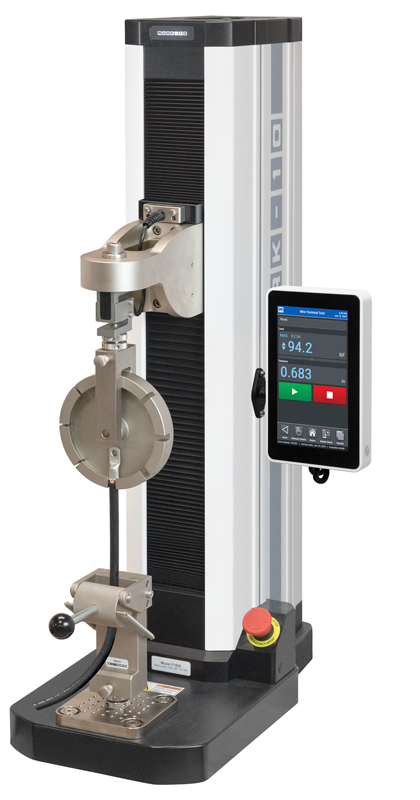
Series F test frames with EasyMESUR® are designed to perform a wide variety of tensile and compression tests, including break testing, cyclic testing, load or displacement limit testing, load holding, average force testing, and many more.
Test setup and execution, result export, and report generation are performed directly through the integrated, user-friendly touchscreen interface, eliminating the need for a PC or an external force gauge. For specialized applications, the system can also be operated from a PC through a custom application using the EasyMESUR® serial command library.
Sample setup and fine positioning are quick and easy thanks to the force-based FollowMe® feature, which allows the crosshead to move at a variable speed simply by pushing or pulling the force gauge or load cell by hand as a guide.
Built on a modular functional platform, the EasyMESUR® run screen can be configured with large, simple controls for basic applications or adapted to more advanced testing requirements through optional features such as distance measurement, graphing, automatic cycling, and more. These functions may be purchased at the time of order or enabled later in the field using activation codes. All systems are supplied with a 160-hour evaluation mode in which all functions are available.
Generous travel, clearance, and throat depth dimensions accommodate specimens of various shapes and properties. The modular mechanical design supports single- and dual-column extensions for testing large specimens. In addition, the system is compatible with a wide range of force sensor capacities and an extensive selection of grips and accessories.
.
Rigid and Accurate by Design
Exceptionally rigid frames feature custom extrusion designs engineered for maximum stiffness. Factory compensation of the test frames and force sensors ensures a position accuracy of ±0.006 in (0.15 mm) under any load and at any position.
Stepper motors and controllers drive a precision ball screw and linear guide system for smooth, quiet operation with virtually no speed variation under load.
Limit Switches
Upper and lower solid-state limit switches can be used as test limits or test exceptions. Dual-scale rulers assist with accurate switch positioning.
Easy-to-Service Electronics
Most electronics are housed within an integrated module that can be easily replaced without tools or special procedures.
Applications
All Series F models with EasyMESUR® can perform a wide variety of tensile and compression tests, including peel, adhesion, compression, flexural, and functional testing.
Selection of the appropriate model depends primarily on the required force capacity, application demands, and frame configuration.
| Feature | F755-EM | F755S-EM | F1505-EM | F1505S-EM |
|---|---|---|---|---|
| Maximum Force Capacity | 750 lbF (3.4 kN) | 750 lbF (3.4 kN) | 1,500 lbF (6.7 kN) | 1,500 lbF (6.7 kN) |
| Column Configuration | Single Column | Dual Column | Single Column | Dual Column |
| Structural Rigidity | High | Very High | High | Very High |
| Application Type | Industrial | Heavy Industrial | Heavy Industrial | Heavy Industrial / High-Demand |
| Frame Orientation | Vertical and Horizontal | Vertical and Horizontal | Vertical and Horizontal | Vertical and Horizontal |
| Recommended Specimens | Medium | Medium to Large | Large | Large and Rigid |
| Key Differentiator | Higher Capacity than F505 | Greater Stability and Precision | High Force Capacity | Maximum Structural Stability |
Note: EM = EasyMESUR®
 The F755-EM, F755S-EM, F1505-EM, and F1505S-EM models share the same EasyMESUR® platform and functional capabilities. Model selection depends primarily on the required maximum force capacity and the level of structural rigidity needed, with the dual-column “S” versions being ideal for large specimens and high-demand testing applications.
 (Agrandar)
Una prueba de pelado (peel test) es un ensayo mecánico que mide la fuerza necesaria para separar dos materiales unidos por un adhesivo, recubrimiento o unión, aplicándola a un ángulo y velocidad controlados (como 90°, 180° o en T) para evaluar la fuerza de adhesión y la integridad de la unión, crucial en industrias como embalaje, automotriz y electrónica. Esta prueba cuantifica qué tan bien se pegan dos superficies, identificando puntos de falla y asegurando calidad y durabilidad del producto final.


 You can chat directly with us using our live chat feature.



