
 +52 33 3817 0140 | +52 33 3817 8122

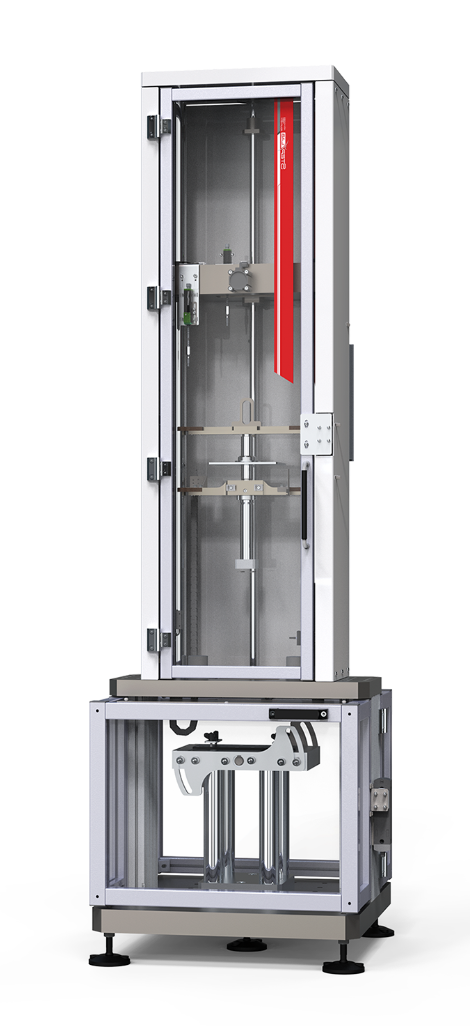
DW 1000 - Drop Weight Tower Impact Tester
High reliability – High efficiency – Modular structure for a wide range of applications
.
📘 General Description
Automatic weight recovery system and velocity measurement.
The DW 1000 Free Fall Drop Weight Impact Tester is designed to perform high-energy impact tests on plastics, composites, metals, and structural components.
It operates using the free-fall weight principle and complies with international standards such as ASTM D3763, ASTM D4272, ASTM D5628, ISO 6603-2, and ISO 7765-2.
Its digital control system and optical velocity measurement ensure maximum precision, repeatability, and safety.
This model incorporates the ImpactStar software, which enables advanced data acquisition and analysis, test management, and automatic report generation.
🧩 General Features
STEP Lab impact testing systems, integrated into the DW series, are designed for single-axis or multi-axis impact testing on products and standardized specimens.
These systems allow testing with energies ranging from 0.2 to 2000 J, making them ideal for a wide range of materials and industrial applications.
Their robust design and large testing chamber facilitate the placement of specimens of different dimensions.
Additionally, the equipment can be complemented with a wide range of optional accessories, such as:
- Instrumented load cells
- Anti-rebound systems
- Spring accelerators
- Interchangeable impactors and specimen holders
⚙️ Main Technical Specifications
| Parameter | Value |
| Drop height | 0,05 – 1,4 m |
| Impact velocity (without acceleration) | 5,0 m/s |
| Impact velocity with acceleration | 10,0 m/s |
| Velocity measurement | High-precision optical sensor |
| Energy range | Up to 1000 J |
| Standard drop weight | 70 kg |
| Drop weight with acceleration | 20 kg (at 10 m/s) |
| Signal acquisition speed | 3,5 MHz |
| Signal intensity resolution | 16 bits |
| Foot loading point | 16.000 N/cm² |
| Compressed air pressure | 6 – 8 bar |
| Test area (W × D × H) | 800 × 1400 × 650 mm |
| Overall dimensions (W × D × H) | 800 × 1400 × 3500 mm |
| Equipment weight | 1100 kg |
💻 Control System and Software
The ImpactStar software operates in a Windows environment and provides an intuitive user experience with powerful analysis and control capabilities.
Main functions:
- Complete digital control of the test
- Individual or batch test execution
- Force-time and absorbed energy curve analysis
- Flexible parameter configuration
- Multi-level safety management
- Intuitive touchscreen graphical interface
- Automatic report generation and integrated database
🧰 Standard Accessories
- Interchangeable hammers and anvils according to international standards
- Optical velocity detector
- ImpactStar software with graphical result visualization
- Safety cage protection system
- Adaptable supports for specimens of different sizes
⚗️ Applications
- Single-axis or multi-axis impact testing on plastic, metallic, or composite materials
- Determination of absorbed energy, deformation, and impact resistance
- Quality control, product development, and material validation
- Research testing and dynamic failure analysis
 (Agrandar)
¿que es un pendulo de impacto caída libre? Las Torres de Caída de Peso son sistemas diseñados para realizar pruebas de impacto monoaxiales y multiaxiales en productos o especímenes normalizados. Permiten ajustar energías de impacto entre 5 y 2000 julios (J), lo que posibilita ensayar una amplia variedad de materiales y componentes. Gracias a su estructura modular y amplia zona de ensayo, pueden adaptarse a diversas necesidades industriales y actualizarse fácilmente.


 You can chat directly with us using our live chat feature.



